








SSL/TLS certificates in cloud and multi-cloud environments: why management is becoming more complex
June 30, 2026 | Jordi Genescà Prat
Certificados SSLCertGuardian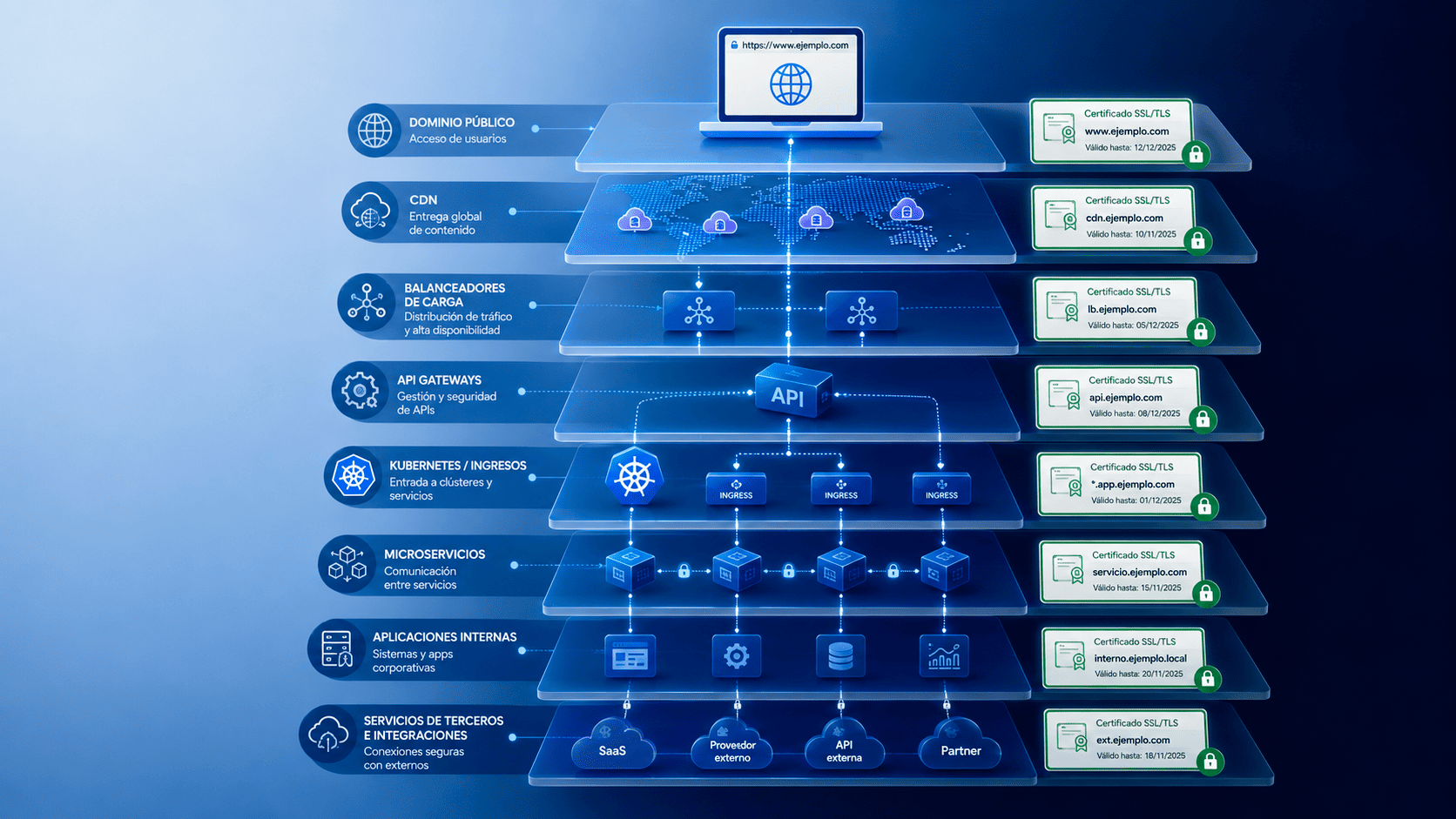
The adoption of cloud environments has changed the way companies deploy, scale and connect their digital services.
Today, a website, an application or an internal platform no longer necessarily depends on a single server or a single provider. It may rely on AWS, Azure, Google Cloud, private servers, CDNs, load balancers, API gateways, Kubernetes, microservices, internal certificates or third-party services.
This evolution brings flexibility and growth capacity, but it also adds a new layer of complexity: SSL/TLS certificate management.
Because, in a distributed architecture, certificates are no longer always located in the same place. They may be involved in traffic entry points, service-to-service communication, APIs, production environments, staging environments or internal integrations.
And if there is no cross-environment visibility, it is easy to lose sight of which certificates are active, where they are used, which services depend on them and what impact a failure could have.
Infrastructure is no longer in one place
For years, many companies managed their SSL/TLS certificates in relatively centralised environments: a corporate website, a hosting provider, a few subdomains and, in some cases, one or more private servers.
But that scenario has changed.
Today, it is common for a company to have part of its infrastructure in the public cloud, maintain internal systems, use SaaS applications, connect services through APIs, work with separate development and production environments or deploy applications in containers.
This means that security and availability no longer depend on a single environment. They depend on a more distributed architecture, with more connection points, more technical layers and more interdependent services.
In this context, SSL/TLS certificates are no longer an element associated only with the main website. They become part of many pieces of the infrastructure: from the public perimeter to internal communication between applications.
In the cloud, certificates can live across many layers
One of the main challenges of cloud, hybrid and multi-cloud environments is that SSL/TLS certificates can be deployed in very different places.
They may be associated with a public domain, a subdomain, a load balancer, a CDN, an API gateway, an internal application, a customer-facing service, a staging environment, a Kubernetes cluster or a third-party integration.
In many cases, the certificate is not installed directly on the server where the application runs. It may be located in a previous layer, where TLS termination takes place, for example, in a load balancer, a CDN or a Kubernetes ingress controller.
This is common in modern architectures, but it also complicates traceability.
A certificate may protect end-user access to a platform, but it may also secure communication between internal services, APIs, microservices or systems that are not externally visible.
That is why, in cloud infrastructures, it is not enough to know whether the main website has a valid certificate. It is necessary to understand in which layers SSL/TLS certificates are used and what role each one plays within the architecture.
Each provider has its own way of managing certificates
Another factor that complicates management is that each provider may have its own system for issuing, installing, renewing or monitoring certificates.
AWS, Azure, Google Cloud, hosting providers, CDNs, SaaS platforms or private environments may all have different panels, rules, permissions, automations and processes.
In some cases, certificates are managed through the cloud provider’s native tools. In others, they are associated with load balancers, gateways, managed services, virtual machines, containers or configurations owned by the technical team.
This can work well when each environment is managed in isolation. But the problem appears when the company needs a global view.
One certificate may be renewed from the panel of a cloud provider. Another may depend on a load balancer. Another may be installed on a private server. And another may be part of a technical integration that only a specific team knows about.
The difficulty is not only technological. It is operational.
When certificates are distributed across several platforms and owners, it becomes harder to know who should act, where the renewal should be carried out and which service may be affected if something fails.
The challenge of Kubernetes, APIs and microservices
Modern architectures have also multiplied the points where an SSL/TLS certificate may be required.
In environments with Kubernetes, APIs or microservices, certificates may be involved in traffic entry points, service-to-service communication, internal connections, development environments or integrations between applications.
For example, in Kubernetes, certificates may be linked to ingress controllers, exposed services, secrets, namespace configurations or automation tools. In API-based architectures, they may protect public endpoints, gateways, internal communications or third-party integrations.
In addition, in some environments, certificates are used not only to encrypt traffic, but also to authenticate services to each other through mTLS. This adds an extra layer of control, but it also increases the need to manage certificates, renewals and dependencies accurately.
This means that some incidents are not as obvious as a “not secure” warning on a website.
As we have explained in previous articles, an expired or misconfigured certificate can cause connection errors between applications, API failures, authentication problems, interruptions in internal services or incidents in platforms that depend on several technical layers.
And because these environments evolve quickly, with new deployments, endpoints, versions and services, SSL/TLS management cannot depend solely on occasional reviews or on each team’s knowledge.
When a certificate fails, it is not always easy to locate the source
In a distributed architecture, a certificate-related failure is not always identified immediately.
The technical team, if the company has one, may need to review different panels, logs, load balancers, ingress controllers, APIs, cloud environments or internal services until it locates the real source of the incident.
And when the problem lies in an expired, incorrectly installed, incorrectly chained or outdated certificate, the solution usually depends on knowing exactly where it is, who manages it and which service it protects.
The more distributed the infrastructure is, the more important it becomes to reduce this diagnostic time. The goal is to prevent a critical element from remaining hidden inside a complex architecture.
Why native tools do not always provide a global view
Many cloud providers offer their own tools for managing certificates within their environment.
This can be useful, but it does not always solve the entire problem.
A company may have certificates managed inside AWS, others in Azure, others in Google Cloud, others on private servers, others in a CDN, others in Kubernetes and others in external services.
Each tool may provide visibility over its own part of the infrastructure, but not necessarily over the whole environment.
This is where one of the main challenges of hybrid and multi-cloud environments appears: fragmented visibility.
If each provider only shows one part, the company may still lack a complete picture of all its SSL/TLS certificates. And without that global view, it is more difficult to anticipate renewals, detect blind spots or understand which services depend on each certificate.
This is especially important when certificates have different owners, different renewal methods and different levels of criticality.
In these scenarios, centralised visibility should not be limited to viewing certificates. It should also make it possible to renew, deploy, audit and trace their status from a common logic.
CertGuardian: visibility, automation and traceability across fragmented environments
In cloud, hybrid and multi-cloud environments, the goal is not to replace every native tool from every provider, but to gain a more cross-environment view and a more automated approach to certificate lifecycle management.
This is where CertGuardian helps simplify management.
CertGuardian centralises SSL/TLS certificate information and provides a clearer view of certificates distributed across different environments, providers and services. This helps identify which certificates exist, where they are used, when they expire and which domains, applications, APIs or services could be affected if they are not managed correctly.
But its value is not limited to visibility. CertGuardian is also designed to automate renewals and deployments, integrating with Certificate Authorities through ACME/API and facilitating certificate installation on servers, load balancers, networks and other technical environments.
It also supports monitoring, alerts, logs, auditing and real-time traceability, helping reduce manual errors, detect incidents and maintain more reliable control over certificate status.
In fragmented infrastructures, this combination of visibility and automation is key to reducing blind spots, anticipating renewals and preventing a certificate from falling outside operational control.
It is also particularly useful when the company works with multiple providers, different Certificate Authorities, cloud environments, legacy systems or hybrid models, as it enables progress towards more centralised management without relying solely on isolated panels or manual processes.
With CertGuardian, SSL/TLS management can move from being a fragmented responsibility to becoming part of a more centralised, traceable operation that is prepared to act in advance.
If your company works with cloud, hybrid or multi-cloud environments, centralising SSL/TLS certificate management is key to reducing risks and gaining control over an increasingly distributed infrastructure.
Centralise SSL/TLS certificate management with CertGuardian.
More cloud requires more SSL/TLS governance
Adopting cloud, hybrid environments or multi-cloud architectures does not only mean deploying services faster.
It also means managing more layers, more connections, more providers and more critical elements for availability and security.
SSL/TLS certificates are part of that infrastructure. They protect access points, communications, APIs, applications and services that may be essential to the company’s daily operations.
That is why, as architectures become more distributed, SSL/TLS management needs to evolve.
It is no longer enough to review the certificate of the main website or trust that each provider will manage its own part. A more global, more organised and more proactive view is needed.
In a cloud, hybrid or multi-cloud environment, having control over SSL/TLS certificates also means having control over a key part of the company’s digital continuity.