









How to prepare an internal SSL/TLS certificate audit in your company
June 17, 2026 | Jordi Genescà Prat
Certificados SSLCertGuardian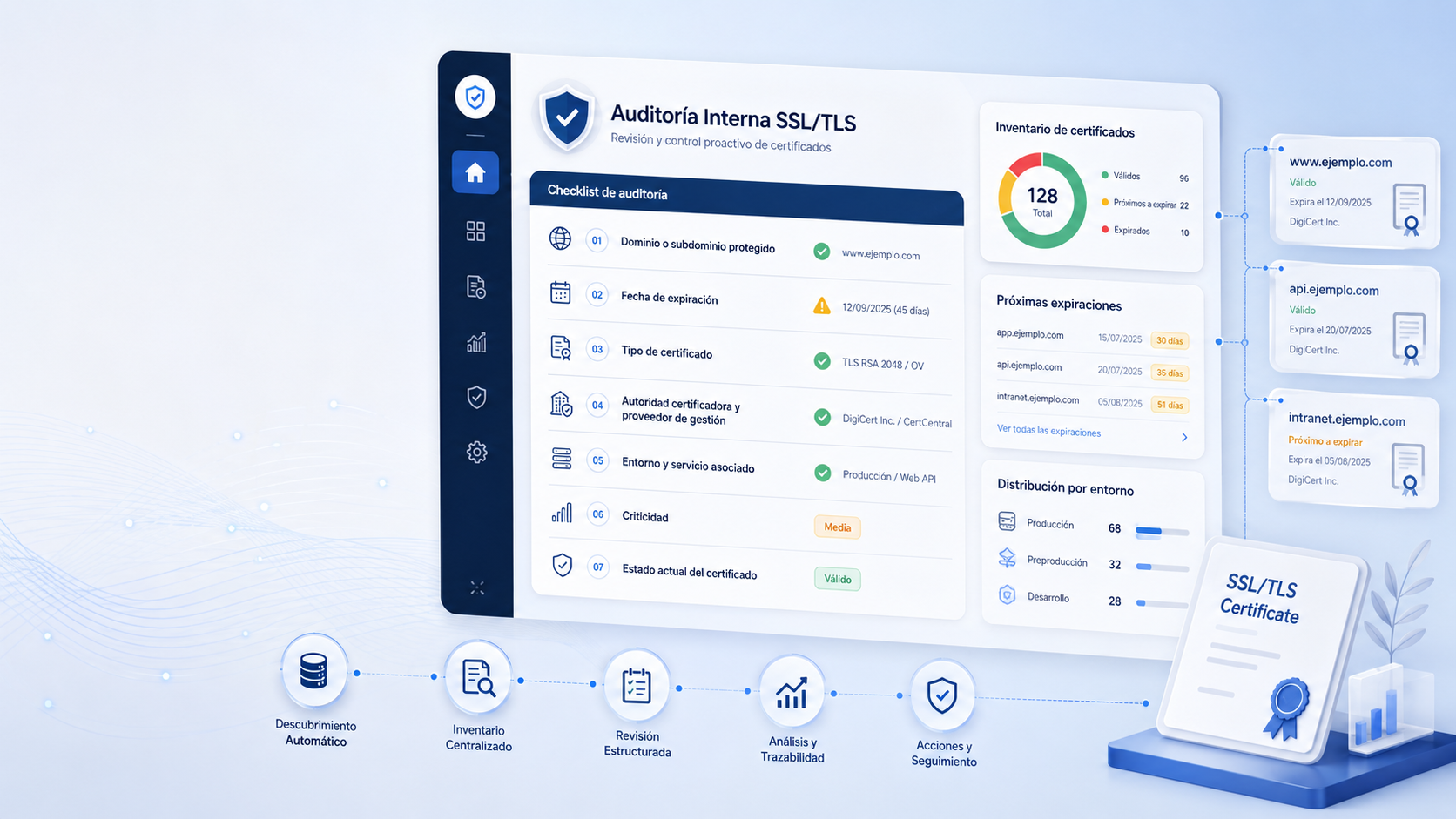
Auditing a company’s SSL/TLS certificates should no longer be seen as a one-off technical review.
With the progressive reduction in certificate lifespans, renewals are becoming more frequent and manual management is becoming increasingly difficult to control. That is why companies need to know which certificates they have, when they expire, which services they protect and how they will be renewed.
An expired certificate can cause numerous problems, loss of trust, SEO loss or incidents in critical applications.
Preparing an internal SSL/TLS certificate audit is the first step towards regaining control. It also helps explain why solutions such as CertGuardian make it possible to centralise, inventory and manage certificates automatically, in a much more organised and straightforward way.
Why audit your company’s SSL/TLS certificates
Many companies do not have a clear view of all the SSL/TLS certificates they use. And this can happen both in organisations with many certificates and in companies with only a few domains or an apparently simple digital structure.
There may be certificates associated with the corporate website, subdomains, online stores, private areas, internal applications, APIs, servers, cloud platforms or services managed by external providers.
The problem appears when that information is spread across different departments, panels or providers. While everything is working, this dispersion can go unnoticed. But when an expiry date approaches, a security warning appears or a service stops responding, the lack of visibility becomes an urgent issue.
An internal audit helps answer key questions:
- How many SSL/TLS certificates does the company really have?
- Which domains, subdomains or services do they protect?
- When does each one expire?
- Which provider or platform is each one managed from?
- What impact would it have if one of them failed?
- Is there a clear plan to renew them on time?
Answering these questions makes it possible to move from reactive management to a more organised, preventive approach aligned with business continuity.
Checklist for auditing SSL/TLS certificates
An internal SSL/TLS certificate audit should collect the information needed to know which certificates exist, what role they play, what level of risk they carry and how they should be renewed.
These are the key points you should review.
1. Protected domain or subdomain
The first step is to identify which domain or subdomain each certificate protects.
It is not enough to review the main website: you also need to consider certificates on corporate subdomains, ecommerce sites, customer private areas, internal panels, web applications, APIs, intranets, development environments or third-party services connected to the domain.
This point is important because many forgotten certificates are not on the main website, but in secondary environments that are still necessary for daily operations.
2. Expiry date
The expiry date is one of the most important pieces of data in the audit.
Each certificate should have its expiry date recorded, as well as an internal review or early renewal date. Waiting until the last minute increases the risk of errors, blocks or incidents.
With increasingly shorter SSL/TLS certificates, this review will become even more important. Companies will need to renew and validate certificates more frequently, so relying only on manual alerts or scattered reminders is no longer enough.
Without this information, any certificate can become an unexpected incident.
3. Type of certificate
It is also useful to identify which type of certificate is being used.
Not all certificates fulfil the same function or offer the same level of validation. That is why, as part of the audit, it is advisable to classify whether it is a DV certificate, for domain validation; OV, for organisation validation; EV, for extended validation; Wildcard, to protect multiple subdomains; or multidomain/SAN, to protect several domains or alternative names.
This helps determine whether the current certificate is suitable for how it is being used. Auditing the type of certificate makes it possible to detect inconsistencies, duplications or potential consolidation opportunities.
4. Certificate authority and management provider
In many companies, SSL/TLS certificates are not managed from a single provider. Some may be issued by a certificate authority, others purchased through the hosting provider, others managed by an agency, others through a cloud provider and others from internal platforms.
That is why the audit should record both the certificate authority that issued the certificate and the provider, platform or account from which it is managed. This distinction is important because, when renewing or resolving an incident, the company needs to know where to act, who has access and which provider is involved.
5. Environment and associated service
An SSL/TLS certificate can be installed in different environments and protect very different services.
It is not always found only on the public website. It may also be installed on web hosting, an owned server, a cloud provider, a CDN, a load balancer, an internal application, an API, a development environment, an ecommerce platform, a private area or an external service.
In addition to identifying where it is installed, the audit should specify which service depends on each certificate. A certificate associated with a secondary landing page is not the same as one linked to an online store, a payment gateway, a lead generation form, an intranet or a customer platform.
Documenting this information helps understand the real impact of an expiry and prioritise which certificates require greater control.
6. Criticality and current certificate status
Not all certificates have the same importance. A useful audit does not only list certificates; it also classifies them by criticality.
You can use a simple classification:
- High criticality: certificates associated with ecommerce, private areas, critical applications, APIs, payment gateways, authentication services or customer platforms.
- Medium criticality: certificates linked to corporate websites, commercial forms, relevant landing pages or digital services with an impact on lead generation.
- Low criticality: certificates for test environments, secondary services or assets with low external impact.
In addition, the audit should review the current status of each certificate. It is necessary to check whether it is active or expired, whether it matches the correct domain, whether the certificate chain is valid, whether the HTTPS configuration works correctly, whether browser warnings exist, whether there are installation errors or whether the certificate is close to renewal.
This control makes it possible to detect problems before they affect the end user.
How CertGuardian helps manage certificate audits and renewals
An internal audit helps you understand the company’s current situation. But the real value lies in turning that audit into continuous management.
This is where CertGuardian helps take the next step.
CertGuardian makes it possible to centralise SSL/TLS certificate information in a single environment, providing a clear view of which certificates exist, when they expire, which domains or services they protect and what actions are needed to keep them under control.
Instead of relying on spreadsheets, manual reminders or information spread across different providers, CertGuardian helps build a more organised and easier-to-follow system. The company can maintain a centralised inventory, control expiry dates, anticipate renewals, reduce manual errors, gain visibility over domains, services and providers, avoid forgotten certificates and prepare renewals with more margin.
It also enables more controlled management of the certificate lifecycle. This is especially important for companies with many certificates, but also for organisations with only a few domains that do not want a forgotten renewal to become an emergency.
In this way, the audit stops being a one-off action and becomes part of a safer, automated SSL/TLS management process, prepared for an environment in which certificates will have increasingly shorter lifecycles.
If you want to centralise your SSL/TLS certificates, control expiry dates and anticipate renewals before they become urgent, you can do so here:
Manage your SSL/TLS certificates with CertGuardian.
Audit today to manage better tomorrow
Preparing an internal SSL/TLS certificate audit is not just a technical task.
It is a way to protect the availability of digital services, user trust, website security and the company’s operational continuity.
Knowing which certificates you have, when they expire, where they are installed, which services they protect and what impact a failure would have allows you to make better decisions and reduce the risk of unexpected incidents.
In a context where renewals will become increasingly frequent, auditing certificates is the first step towards no longer managing them reactively and starting to treat them as an essential part of the company’s digital infrastructure.