








How to reduce the operational cost of managing SSL/TLS certificates
June 12, 2026 | Jordi Genescà Prat
CertGuardian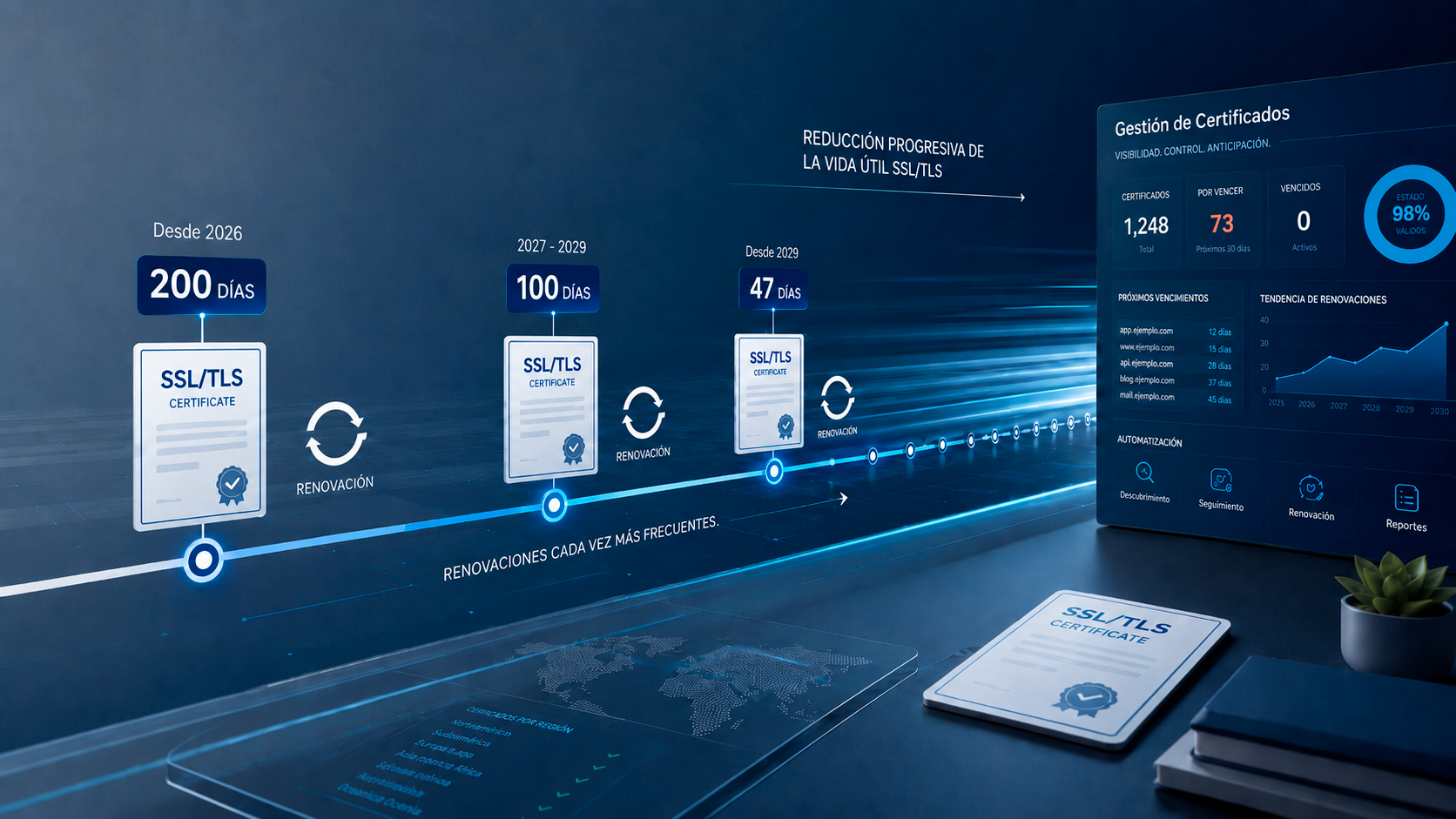
Managing SSL/TLS certificates may seem like a purely technical task.
Renewing, installing, validating, checking expiry dates and making sure everything continues to work correctly. Seen this way, it looks like just another part of website maintenance.
But this management is about to become much more demanding for companies.
The progressive reduction in the lifespan of SSL/TLS certificates will make renewals more frequent and manual processes increasingly less sustainable. What could once be managed once a year will require much more regular attention.
And this will affect both companies with many certificates and smaller organisations with a corporate website, an online store, a private area or a few digital services.
Because the cost is not only in the price of the certificate.
That is why reducing the operational cost of managing SSL/TLS certificates is no longer just about buying cheaper certificates. It is about being prepared for a scenario in which they will need to be renewed, validated and controlled much more frequently.
And in this context, having a solution like CertGuardian is no longer just an operational improvement. It becomes a way to avoid emergencies, errors and loss of control.
The real cost of an SSL/TLS certificate is not just its price
When a company analyses the cost of its SSL/TLS certificates, it often focuses only on the direct cost: how much it costs to issue or renew each certificate.
But that is only part of the calculation.
The real cost appears when all the tasks associated with the day-to-day management of those certificates are taken into account.
For example, checking which certificates are active, knowing when each one expires, coordinating renewals, validating domains, installing certificates on different servers, resolving errors, responding to tickets, contacting providers or acting urgently when an expiry date is approaching.
In organisations with few domains, this work can become difficult to manage, especially due to the progressive reduction in certificate validity periods. And when the number of domains and certificates within a company grows, the manual model creates even more friction.
And all that time and work has a cost.
Shorter SSL/TLS certificate lifespans: a change that has already begun
SSL/TLS certificate management is entering a new stage following the approval of the progressive reduction in the maximum validity of SSL/TLS certificates: from 398 days to just 47 days in 2029. And this is not only something that will happen in the future; it is a process that already began on 15 March 2026, when the maximum validity of certificates was reduced to 200 days.
The planned calendar includes two other key dates:
- 15 March 2027: the maximum validity will be reduced to 100 days.
- 15 March 2029: new SSL/TLS certificates will be limited to 47 days.
This means that companies will have to renew and validate certificates much more frequently. What until now could be managed as an annual or occasional task will become part of a recurring operation, with less room for oversight, improvisation or dependence on manual reminders.
The impact will be direct both for companies with many certificates and for organisations with one or only a few. In a company with dozens of certificates, the number of renewals, validations and reviews will multiply. But in a small company, a single expired certificate can also cause security warnings, loss of trust, interruptions in an online store, problems with forms or incidents in private areas.
The shorter the certificate lifespan, the less room there is to manage it reactively.
And this is where a solution like CertGuardian becomes especially relevant: it makes it possible to centralise information, control expiry dates, anticipate renewals and reduce dependence on manual processes in a context where certificates will need to be managed more frequently and automatically.
Reactive management, scattered providers and lack of visibility
With this new calendar for reducing the lifespan of SSL/TLS certificates, the room for managing renewals reactively will become increasingly smaller.
Until now, many companies could operate with a model based on occasional alerts, manual reminders, spreadsheets or periodic checks. In other words, acting when a notification arrived, when someone detected an upcoming expiry date or when an incident had already occurred.
But if certificates need to be renewed and validated more frequently, this model becomes much more fragile.
If someone misses an alert, if a spreadsheet is not up to date, if a certificate was issued through another provider or if nobody is clear about who is responsible for the renewal, the risk of error increases. And with shorter lifecycles, the time available to correct it is also reduced.
This problem affects both companies with many domains and certificates and organisations with a simpler digital structure. In large companies, the difficulty is usually volume: multiple domains, subdomains, providers, departments, servers, applications, APIs or internal services. In companies with one or only a few certificates, the risk usually lies in the lack of process: there is not always a dedicated IT team, management may depend on an agency, the hosting provider or an internal person, and any oversight can quickly become an incident.
In addition, in a small company, an SSL/TLS incident can have an immediate effect. A website showing a “not secure” warning, a form that stops working, an inaccessible private area or an online store with trust issues can directly affect sales, potential customers or reputation.
The problem becomes worse when certificates are spread across different providers, platforms, accounts or departments. Certificates may be managed through hosting, an external agency, a cloud provider, a domain panel or several internal environments: corporate websites, applications, servers, APIs, intranets, private areas or third-party services.
If there is no clear inventory, the company does not always know how many certificates it has, where they are installed, who manages them, when they expire or which domains and services they protect. And without that information, anticipating problems becomes much more difficult.
The consequence is not only administrative. A forgotten certificate can become an emergency, a service outage, a “not secure” warning, a loss of user trust or a critical ticket that pushes other priorities aside.
In a context where certificates will have an increasingly shorter lifespan, reactive management stops being a convenient way of working and becomes an operational risk. The more frequent renewals become, the more important it will be to have visibility, traceability and the ability to anticipate.
CertGuardian: turning SSL/TLS management into a controlled process
In a scenario where SSL/TLS certificates will have an increasingly shorter lifespan, companies need more than occasional reminders or manual checks. They need a system that helps them turn certificate management into an automatic, organised, visible and easy-to-follow process.
CertGuardian responds precisely to this need, helping to simplify day-to-day management and reduce the operational risk associated with each certificate.
Its main advantages include:
- Centralised certificate inventory: to reduce costs and avoid errors, companies first need to know what they are managing. CertGuardian brings together the key information for each certificate in a single environment: which ones are active, when they expire, which domains or services they protect, who manages them, where they are installed, which provider issued them and which ones require renewal or review.
- Better operational decisions: with a clear view of the SSL/TLS certificate estate, the company can detect duplicates, consolidate providers, prioritise renewals, anticipate incidents and reduce manual tasks. Visibility stops being only a technical advantage and becomes a way to optimise time, resources and costs.
- Greater ability to anticipate: instead of acting when the certificate is about to expire or when an incident has already occurred, the company can know in advance which certificates require attention and when it needs to act.
- Less dependence on specific people: if SSL/TLS management depends on a single person, an external agency or a specific provider, any absence, internal change or lack of communication can create problems. With CertGuardian, the information is centralised and available, making it easier to maintain control even if responsibilities change or several teams are involved.
- Reduction of manual errors: the more certificates need to be renewed, validated or reviewed, the greater the chance of duplicating tasks, forgetting expiry dates, renewing late or not knowing which certificate protects each service. CertGuardian helps automate and organise this information and minimise that risk.
- Useful for both large and small companies: for companies with many certificates, it provides a clear improvement in efficiency and coordination. For companies with one or only a few domains, it helps prevent a seemingly small task from becoming an emergency affecting the website, ecommerce, forms, private areas or critical digital services.
In short, CertGuardian not only helps manage SSL/TLS certificates automatically. It also helps save time, reduce incidents, improve operational continuity and face with greater confidence a context in which renewals will become increasingly frequent.
From reactive management to operational control with CertGuardian
The change is not only about organising certificates better, but about moving from a reactive logic to automated management prepared for more frequent renewal cycles.
Manual and reactive management
Automated management with CertGuardian
This change has a direct impact on daily operations.
In a scenario where renewals will become increasingly frequent, the real saving is not only in spending less time on each certificate. It is in reducing emergencies, avoiding errors and keeping under control a key element for the company’s availability, security and digital trust.
Managing SSL/TLS certificates with a business perspective
SSL/TLS certificates are a technical element, but their management has a direct impact on the business.
They affect service availability, user trust, the operation of forms, platforms, private areas or online stores, SEO and the company’s operational continuity.
With the progressive reduction in their lifespan, managing them as an occasional or isolated task will no longer be enough. Both in companies with a single domain and in organisations with multiple certificates, renewals will become more frequent and there will be less room for improvisation, scattered alerts or last-minute action.
The key is to treat SSL/TLS management as part of a strategy based on control, efficiency and prevention.
With a solution like CertGuardian, companies can automate and centralise information, anticipate expiry dates, reduce errors and maintain a clear view of the status of their certificates. In this way, management no longer depends on manual processes and becomes part of a more organised, secure operation prepared for the new scenario.
If you want to reduce the operational load of managing SSL/TLS certificates and gain visibility over their entire lifecycle, you can do so here:
Because the real saving is no longer only in renewing certificates.
It is in no longer managing them as an emergency.