









What really happens when an SSL/TLS certificate expires
July 14, 2026 | Jordi Genescà Prat
Certificados SSLCertGuardian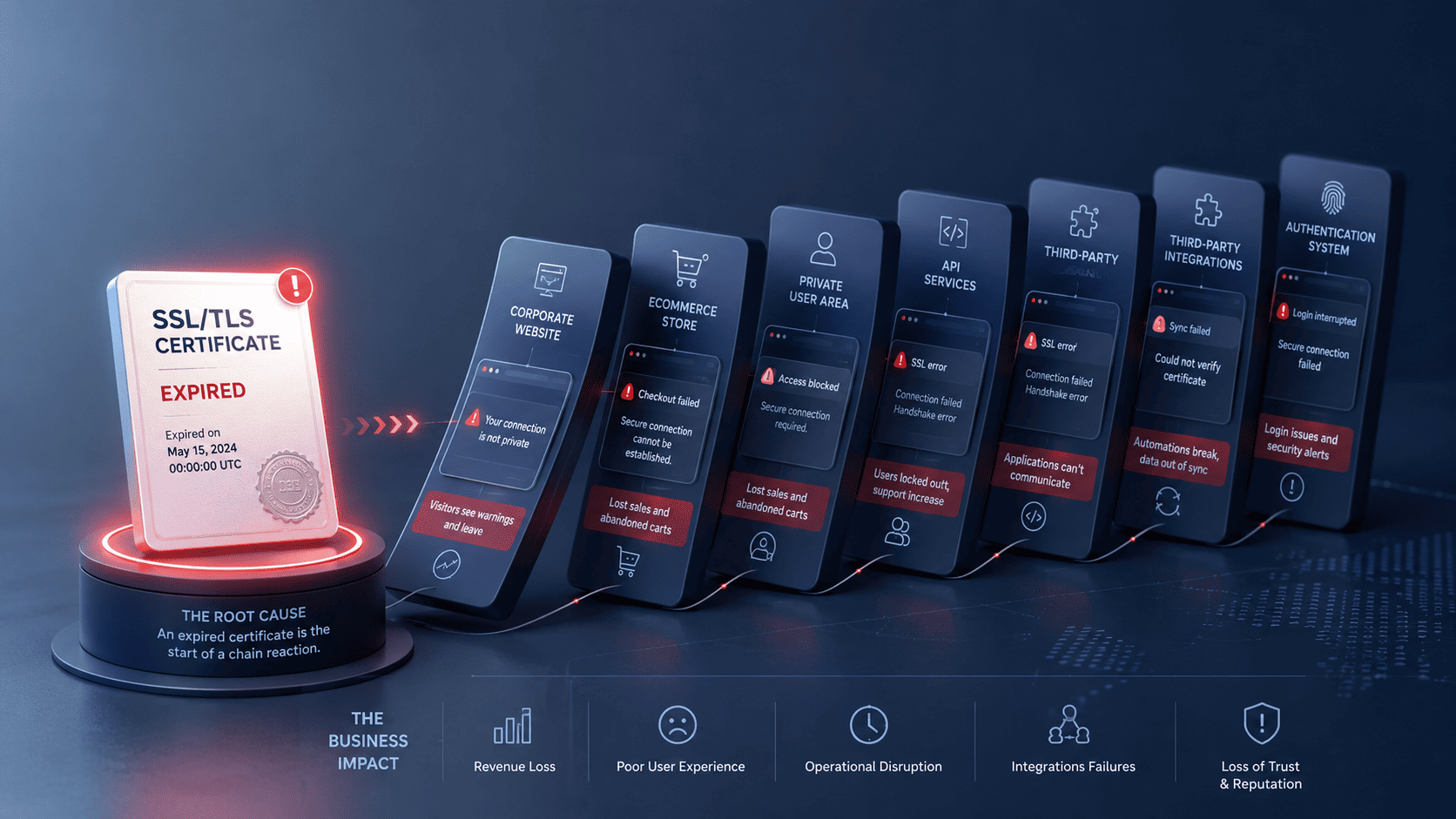
When an SSL/TLS certificate expires, many people only think about the warning that appears in the browser.
But the reality is usually broader.
An expired SSL/TLS certificate can affect a corporate website, an online store, a private area, an API, an internal application, a server, a load balancer, a third-party integration or even an authentication system.
And in many cases, the problem is not detected until it is already affecting users, customers, internal teams or business processes.
That is why certificate expiry should not be seen as a minor incident. It should be understood as an operational, technical and reputational risk.
The first impact: the browser blocks trust
The most visible effect of an expired SSL/TLS certificate appears in the browser.
When a user tries to access a website with an expired certificate, the browser may display a security warning indicating that the connection is not private or that the site is not secure.
For a company, this message has an immediate impact.
Even if the website is still technically available, the user perceives risk. They may leave the page, lose trust in the brand or decide not to complete a purchase, form or request.
On a corporate website, this affects the company’s professional image.
In ecommerce, it can directly affect sales.
In a private area, it can prevent customers, employees or users from accessing the service normally.
The problem is not only technical. It is also a loss of trust.
In ecommerce, an expired certificate can stop sales
In an online store, trust is critical.
If a user reaches a product page, starts a purchase process or accesses the checkout and the browser displays a security warning, they are very likely to abandon the process.
Even if the issue is resolved quickly, the impact can be significant.
An expired certificate can cause lost sales, more enquiries for the support team, wasted marketing campaigns and a poorer user experience.
In addition, if the problem affects payment gateways, connections with logistics providers, billing systems or integrations with external platforms, the incident can extend beyond the visible part of the store.
That is why, in ecommerce, an SSL/TLS certificate is not just a security element. It is also part of business continuity.
Private areas can also be affected
Many companies have private areas for customers, employees, distributors, partners or registered users.
When a certificate expires in one of these environments, the impact can be especially sensitive.
The user may be unable to access documents, orders, invoices, management panels, contracted services or internal tools. And even if the service continues to run in the background, the security warning can undermine trust or prevent normal access.
In these cases, the incident does not always affect the general public, but it does affect key users.
And this can generate calls, tickets, complaints and additional workload for technical and customer service teams.
APIs can fail even if the website appears to be working
One of the most common mistakes is thinking that SSL/TLS certificates only affect visible websites.
But many digital infrastructures depend on APIs.
An API can connect a website with a mobile application, an ecommerce platform with an ERP, a platform with a CRM, a payment gateway with an internal system or several services with each other.
If the SSL/TLS certificate associated with an API expires, connections can start to fail.
This can cause errors in mobile applications, interruptions in automated processes, synchronisation failures, integration problems and the loss of operational data in real time.
The most complex part is that, sometimes, the end user does not see a clear expired certificate message.
They simply see that something is not working.
An application does not load, an order does not synchronise, an integration stops responding or an automated process fails without an obvious explanation.
In some cases, the expired certificate is not even associated with a public website, but with internal communication between services, applications or authentication systems.
Third-party integrations can be interrupted
Many companies work with external services: technology providers, SaaS platforms, payment systems, marketing tools, CRMs, ERPs, security gateways, cloud services or partners.
These integrations often depend on secure connections.
When a certificate expires at one end, communication can be interrupted. And this can happen whether the certificate belongs to an internal service or is installed on a system acting as an intermediary.
The result can be difficult to diagnose.
From the outside, it may look like an integration failure, an authentication error, a service outage or a configuration problem. But the root cause may simply be an expired certificate that nobody had properly located or monitored.
That is why certificate management should not be limited to the company’s main domains.
It should also include connected services, technical subdomains, endpoints, intermediate environments and digital assets that are involved in critical processes.
The impact also reaches support and reputation
When a certificate expires, the technical team is not the only one affected.
The customer service team may start receiving enquiries. The sales team may notice that forms or the checkout are not converting. Marketing may see that a campaign is sending traffic to a page that generates distrust. Management may receive alerts from customers or partners before the incident has been clearly identified.
The longer it takes the company to detect and resolve the problem, the greater the impact can be.
And even once the incident is resolved, trust may take longer to recover.
For a user, a security warning on a corporate website, an online store or a private platform can be enough to question the company’s reliability.
In sectors where security, availability and digital trust are critical, this type of error can directly affect brand perception.
Why certificates still expire
The question seems simple: if certificates have an expiry date, why do they still expire without control?
The answer is usually found in operational complexity.
Many companies manage certificates distributed across different providers, panels, departments, servers, cloud services, load balancers, CDNs, APIs, internal environments or external tools.
Sometimes, renewal depends on a specific person. Other times, the certificate is documented in a spreadsheet that is not updated. It can also happen that the certificate is renewed, but not deployed correctly across all the systems where it was installed.
In addition, the progressive reduction in the lifespan of SSL/TLS certificates will make renewals increasingly frequent. This increases pressure on technical teams and reduces the margin for relying on manual processes or occasional reviews.
The problem is not usually that the company ignores the importance of certificates.
The problem is that it does not always have full visibility over them.
Renewing does not always mean the problem has been solved
Another important point is that renewing a certificate is not always enough.
A certificate may have been issued correctly, but not installed on the right server. It may have been deployed in one environment, but not in all of them. The intermediate chain may be missing. There may be configuration errors. Or an old certificate may still be active on a load balancer, a CDN or an external service.
That is why good SSL/TLS management should not end with renewal.
It should also include post-renewal checks, technical validations, traceability of the change and monitoring of the real status of the deployed certificate.
The difference between “the certificate has been renewed” and “the certificate is correctly installed and working” can be key to preventing incidents.
How to reduce the risk of expired certificates
Preventing an SSL/TLS certificate from expiring without control requires visibility over the entire certificate lifecycle.
It is not enough to know when it expires. It is also necessary to know where it is installed, which service it protects, who manages it, whether it has been renewed correctly and whether the new certificate has been deployed across all necessary environments.
That is why centralised management helps reduce the risk of errors, oversights and certificates that fall outside control.
With CertGuardian, companies can inventory their SSL/TLS certificates, monitor their status, configure alerts, automate renewals and maintain traceability over renewal, installation and change processes.
This makes it possible to anticipate incidents, reduce manual tasks and prepare the infrastructure for increasingly demanding renewal cycles.
Prevent expired SSL/TLS certificates with CertGuardian.
An expired certificate is not a minor detail
An expired SSL/TLS certificate may seem like a one-off incident.
But its consequences can go far beyond a browser warning.
It can affect user trust, stop sales, block private areas, interrupt APIs, break integrations, generate internal incidents, increase support workload and damage the company’s reputation.
And as certificates move towards shorter lifecycles, this risk will become more frequent if it is not managed in a centralised and proactive way.
That is why SSL/TLS management should be understood as an important part of the company’s security, availability and digital continuity.
Because when a certificate expires, it is not just a technical file that expires.
The user’s trust in the service can expire too.