







New .pay and .latino domains: a new opportunity to expand your brand (and why you should act before launch)
April 16, 2026 | Iñigo de las Heras Nuin
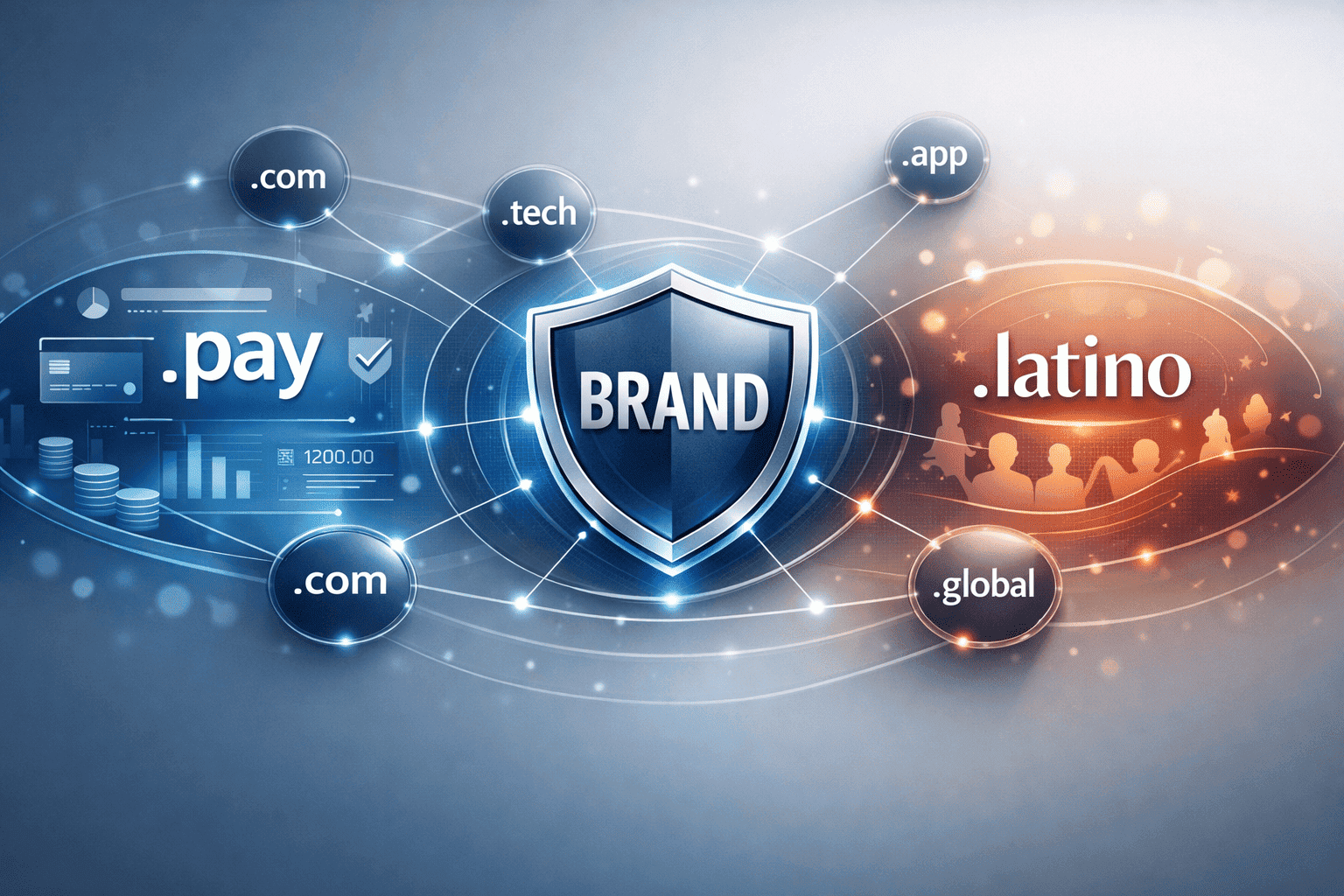
The launch of new domain extensions is not just a technical update, but a strategic opportunity for companies looking to strengthen their digital presence and protect their brand in new environments. Each new extension opens up a space to position yourself, but also one where third parties can get ahead if action is not taken in time.
This is exactly what is happening with .pay and .latino. Two extensions with very different approaches, but with one thing in common: they represent new ways of visibility, positioning and brand protection on the internet.
.pay: trust and conversion in payment environments
The .pay extension is designed for a very specific type of business: those operating in environments where transactions are at the core of the business. Payment service providers, fintech companies or e-commerce platforms find in this domain a direct way to communicate something essential: secure, fast and reliable payments.
Beyond the technical aspect, it is a clear signal for users. In a context where trust is key to completing a purchase, a .pay domain can reinforce that perception from the very first moment. And when trust increases, so does the likelihood of conversion.
More than a domain: a positioning signal
Adopting an extension like .pay is not just an operational decision, but a positioning decision.
It allows you to differentiate your offering in saturated markets, reinforce credibility in payment-related services and attract users who prioritise security and reliability. In sectors where every detail influences customer decisions, these types of elements can make a real difference.
But it also has a direct impact on brand protection.
A very clear example: imagine a user accessing a URL like tubanco.pay. At first glance, it could be interpreted as an official payment platform of the bank. However, if that domain is not controlled by the brand, it could be used by third parties for fraudulent purposes.
In these scenarios, not registering the domain does not mean it will not be used, it means leaving the door open for someone else to do so. And when it comes to payment environments, the impact on trust and reputation can be significant.
The key moment: the Sunrise period
As with all new domains, the launch is structured in different phases. The most relevant for brands is the Sunrise Period.
In the case of .pay:
- Starts on April 13, 2026
- Ends on May 13, 2026
During this period, only registered trademarks can apply for domains, allowing companies to secure strategic names before they become available to the general public.
Without TMCH, there is no priority
To access this priority phase, it is essential for the brand to be validated in the Trademark Clearinghouse (TMCH). Without this validation, companies are excluded from the Sunrise period and lose the advantage of registering their domains before other market players.
This means that any competitor or third party with a validated trademark can move ahead and register key names. And, as is often the case with domains, recovering a name once it has been registered by someone else can be complex, slow and costly.
.latino: identity, community and market
Unlike the functional approach of .pay, the .latino extension follows a completely different logic. Here, the value lies not in transactions, but in identity and cultural connection.
It is aimed at Latin communities and Spanish-speaking diaspora worldwide, as well as companies, brands and organisations that want to connect with this market or strengthen their cultural ties. In addition, anyone can register it, as there are no nationality or entity-type requirements.
This makes .latino an extension with strong adoption potential, but also with a high risk of rapid occupation of relevant names.
Key dates for .latino
The launch of .latino also includes its Sunrise phase:
- Starts on May 12, 2026
- Ends on June 11, 2026
After this phase, the domain will open to the general public on June 12, at which point anyone will be able to register available names.
One scenario, two opportunities that require anticipation
Although .pay and .latino respond to very different needs, both extensions share the same context: they are new spaces assigned under a clear first-come, first-served logic. This means companies that act before launch gain an advantage, while those who wait face a much more limited scenario.
It is not just about deciding whether to register a domain, but about understanding when to do it. In today’s digital environment, many decisions are not measured by immediate urgency, but by their medium-term impact. A domain that may seem secondary today can become a strategic asset tomorrow, especially if it strengthens the brand or prevents misuse by third parties.
Preparing for these launches involves analysing the brand’s situation, validating its presence in the TMCH if necessary, and defining which names are truly strategic for the business. All of this must be done before general availability, because once domains are open to everyone, the room for manoeuvre is drastically reduced.
A one-time opportunity
The launch of new extensions has one key characteristic: it only happens once. It is during this initial phase that brands have the real opportunity to position themselves, protect themselves and secure the names they consider strategic.
Once this stage has passed, the most relevant domains are usually already taken, and any attempt to recover them involves more complex processes, negotiations or even legal disputes. That is why, rather than a one-off action, these launches should be understood as a unique opportunity within a company’s digital strategy.
If you want to understand how to secure your brand in these new extensions or participate in the Sunrise phases, you can do so here: Trademark Clearinghouse.
Because in today’s digital environment, protecting your brand is not about reacting. It is about anticipating.