






Web3 and blockchain domains: what they are, why they are growing and how they can help protect your brand
May 21, 2026 | Jordi Genescà Prat
Web3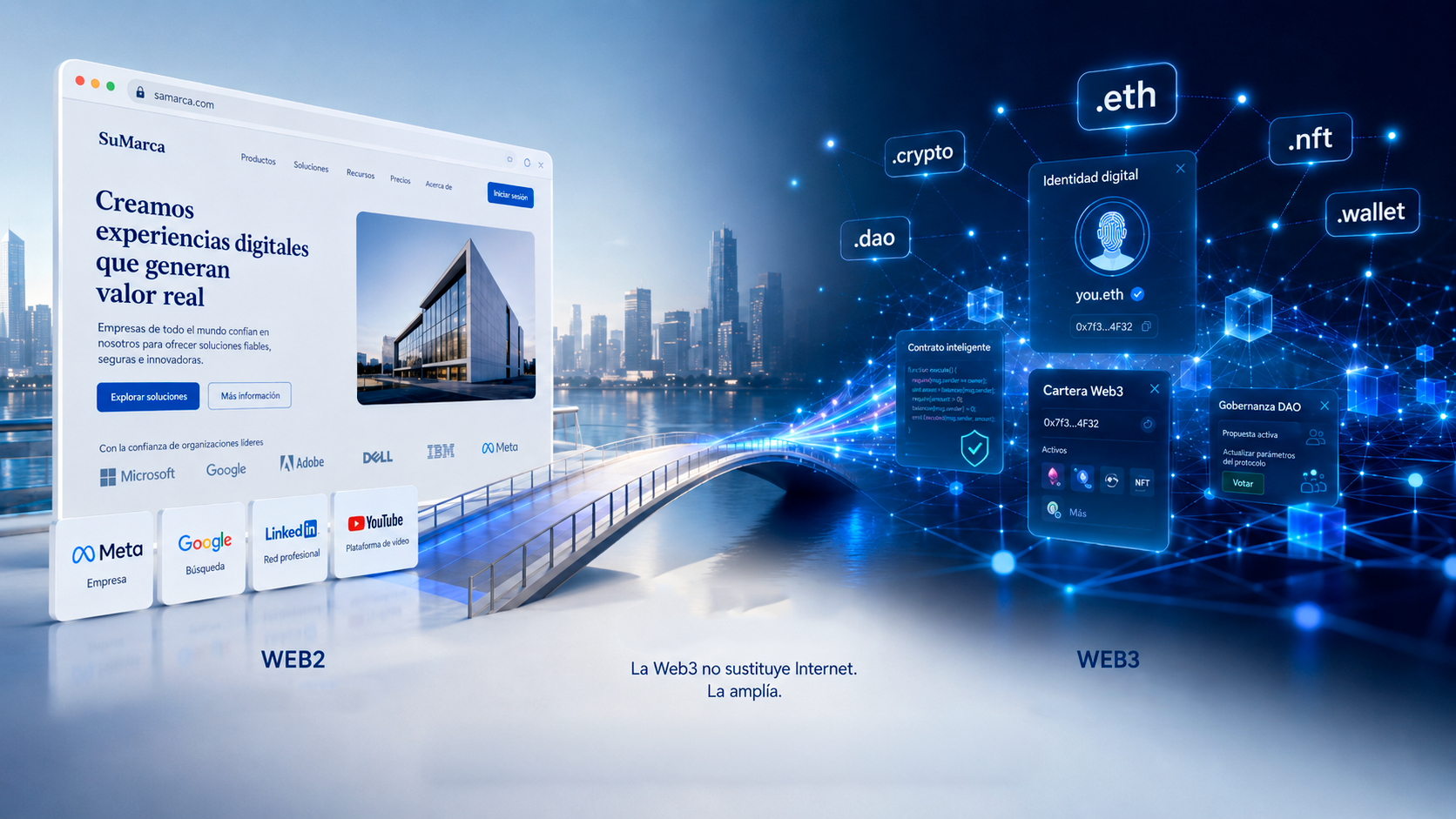
The evolution of the Internet has not stopped.
After years dominated by centralised websites, social platforms and major digital intermediaries, more and more companies are starting to look towards a new scenario: Web3.
Although for a long time this concept has been associated almost exclusively with the crypto world, the reality is that Web3 goes far beyond cryptocurrencies.
We are talking about a new digital environment based on decentralised technologies, blockchain and self-owned digital identities. And within this ecosystem, Web3 domains are starting to play an increasingly relevant role.
But not only as a technological novelty.
Also as a strategic tool to protect brands, strengthen digital identity and anticipate new risks and opportunities.
What exactly is Web3?
Web3 refers to a new generation of the Internet based on decentralised technologies.
Unlike the traditional web, where much of the information and many services depend on centralised platforms, Web3 aims to give users greater control over their data, digital identities and online assets.
All of this is made possible by technologies such as blockchain, smart contracts and decentralised digital identity systems.
Although it is still in a phase of growth and evolution, Web3 is already driving new digital models related to:
- Digital assets and NFTs
- Decentralised finance (DeFi)
- Metaverses and virtual environments
- Decentralised digital identities
- Blockchain platforms
- New forms of digital ownership
And it is precisely within this context that Web3 domains appear.
What are Web3 domains or blockchain domains?
Web3 domains are digital domains registered on blockchain technology.
Unlike traditional domains, which depend on centralised organisations and registries, blockchain domains operate through decentralised networks.
This allows users to have greater control over the domain and over how it is used within the Web3 ecosystem.
In addition, these domains can be used for much more than a website.
For example:
- Linking wallets or crypto addresses
- Identifying digital profiles
- Accessing decentralised applications
- Managing digital assets
- Creating verifiable digital identities
In many cases, these domains replace long alphanumeric addresses with names that are much easier to remember.
Why are Web3 domains growing?
The growth of the blockchain and Web3 ecosystem has led more and more companies, projects and users to start registering domains adapted to this environment.
But interest is not limited solely to the crypto sector.
Many brands are starting to value these domains for several reasons:
New digital opportunities
Web3 is generating new digital spaces where brands want to be present.
In the same way that registering a .com domain became a strategic decision years ago, many companies are now beginning to analyse what role Web3 domains may play in their future digital presence.
Decentralised digital identity
These domains make it possible to create self-owned digital identities within the blockchain ecosystem.
This can be especially relevant for projects linked to digital assets, online communities, decentralised platforms or virtual experiences.
Simplification of blockchain addresses
One of the most widespread uses consists of linking wallets or crypto addresses to easy-to-remember names.
This considerably improves the user experience and reduces errors in transfers and operations.
Brand protection in new environments
And this is where many companies are beginning to pay attention.
Because the real strategic value does not lie solely in using these domains.
It also lies in preventing third parties from registering them first.
Web3 and brand protection: why companies are starting to anticipate risks
Every time a new digital environment appears, a new space also emerges where brands can become exposed. It happened with social media, with marketplaces and with new digital platforms. And now it is beginning to happen with Web3 as well.
Many companies are not yet actively operating within the blockchain ecosystem, but that does not mean their brand cannot appear there. In fact, precisely because it is an emerging environment, there is a risk that third parties may register names, identities or domains linked to a brand before the company itself decides to act.
That is why registering certain Web3 domains can become a preventive and strategic decision. It is not only about being present in the blockchain world, but about preventing others from occupying that space in your brand’s name.
When a company does not protect its identity in new digital environments, it leaves the door open to misuse, impersonation attempts, fraudulent profiles or confusion among users and customers. And in sectors where trust is key, these situations can have a direct impact on reputation.
The logic is very similar to the one already applied with traditional domains: they are not always registered because they are going to be used immediately, but because they form part of a brand protection and control strategy.
In this sense, Web3 should not be understood only as an innovation opportunity, but also as a new territory where anticipating risks can prevent future problems.
Some Web3 domains that are gaining relevance
The Web3 ecosystem already includes different extensions and domain systems aimed at blockchain projects and decentralised environments.
Some of the best known are:
.eth
Probably one of the most popular Web3 domains.
It is linked to the Ethereum ecosystem and is widely used to identify wallets, profiles and decentralised services.
.crypto
Especially focused on the crypto and blockchain environment.
It makes it possible to simplify wallet addresses and create digital identities within the Web3 ecosystem.
.nft
Closely related to projects linked to NFTs, digital art and collectible assets.
.dao
Associated with decentralised autonomous organisations (DAOs), one of the most representative organisational models of Web3.
.bitcoin
Linked to the Bitcoin ecosystem and to projects related to this blockchain network.
.wallet
Focused on services, platforms and tools related to digital wallets and blockchain assets.
Although they still do not have the same widespread use as traditional domains, many companies are already beginning to analyse these spaces from a strategic perspective.
Web3 does not replace the Internet: it expands digital spaces
Traditional domains will continue to be essential for corporate websites, SEO positioning and conventional digital presence.
But that does not prevent Web3 domains from gaining relevance in certain sectors, platforms or digital models.
Digital history shows that the brands that best adapt to technological change are not always the first to adopt new tools, but those that understand early on what impact they may have.
Web3 is still evolving, but it is already creating new digital spaces, new identities and new forms of online interaction.
And that also means new scenarios for brand management and digital protection.
Because on the Internet, protecting a brand often does not simply mean reacting.
It means anticipating the spaces where it may appear tomorrow.