









Automating SSL/TLS certificates does not mean losing control
July 8, 2026 | Jordi Genescà Prat
Certificados SSLCertGuardian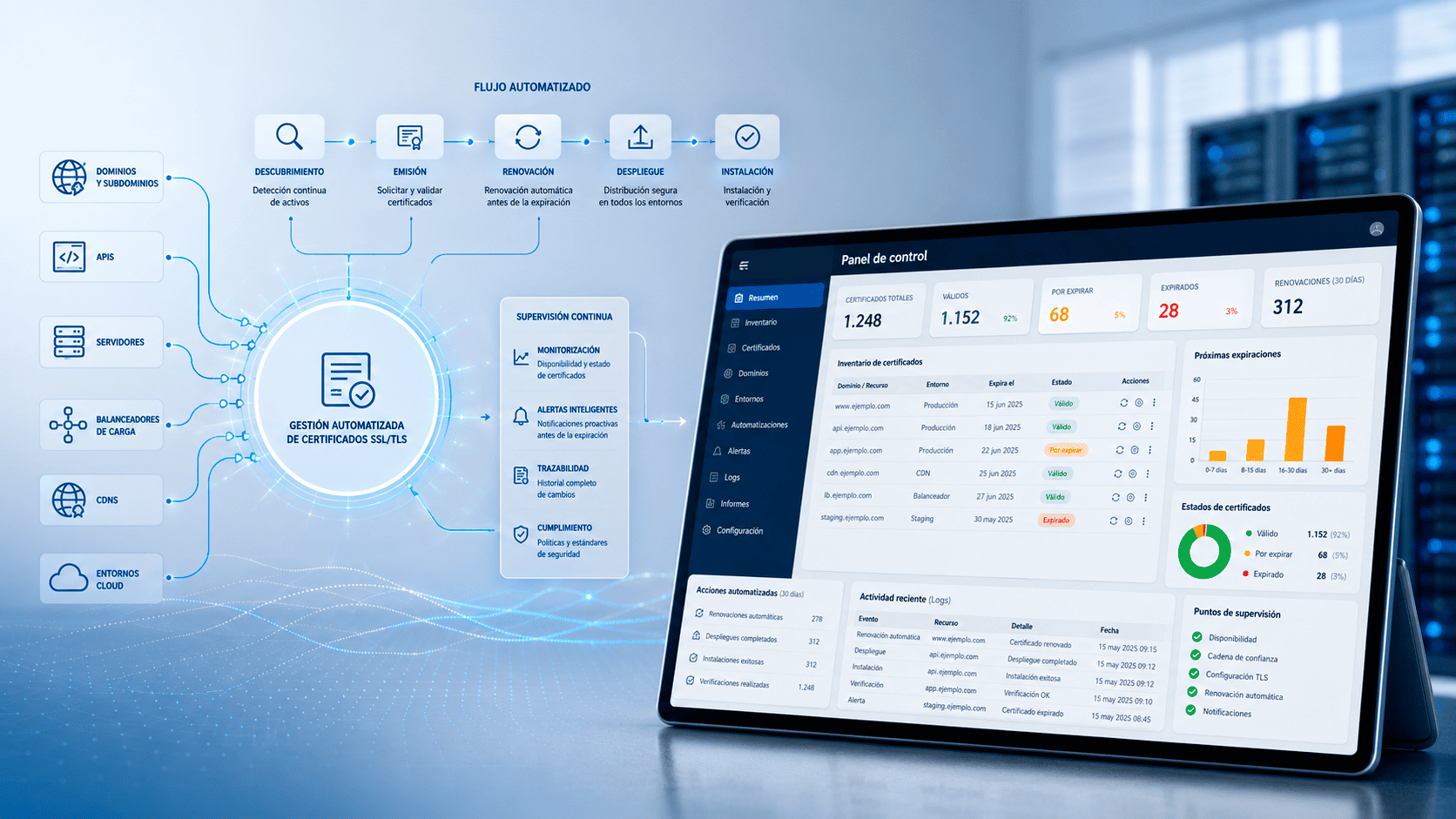
SSL/TLS certificate automation has become a necessity for many companies.
The progressive reduction in the lifespan of SSL/TLS certificates will make renewals increasingly frequent. What used to be managed with long cycles and occasional reviews will require much more continuous attention, especially in companies with multiple domains, subdomains, APIs, servers, load balancers, CDNs or cloud environments.
This is compounded by the growth of digital services and the complexity of cloud, hybrid and multi-cloud infrastructures, which make relying solely on manual processes increasingly unsustainable.
But automation does not mean letting everything run without supervision.
Good SSL/TLS management is not only about renewing certificates automatically. It also means defining which processes can be automated, which actions require validation, which certificates need greater control and how to maintain traceability over every change.
Because, in security, automation should not mean losing control. It should mean reducing errors, gaining visibility and acting with better judgement.
Automation does not mean eliminating supervision
When we talk about SSL/TLS certificate automation, it is sometimes interpreted as if the entire process could be left running without human intervention.
But this approach can be risky.
Not all SSL/TLS certificates are the same. Renewing a certificate associated with a test environment does not have the same impact as updating a certificate on a payment gateway, a critical API, a customer platform, an authentication system or legacy infrastructure.
That is why automation must be designed with clear rules.
Some processes can be executed automatically because they are repetitive, predictable and low-risk. Others, however, should be subject to supervision or technical review before being applied.
The goal is not to choose between automation and control. The goal is to combine both.
Which processes should be automated
Automation provides significant value when it is applied to repetitive, technical and easily verifiable tasks. In SSL/TLS certificate management, some processes should be automated to reduce manual errors, anticipate incidents and free up operational workload for the technical team.
- Monitoring certificate status.
One of the first processes that should be automated is continuous monitoring of certificate status. Knowing which certificates are active, when they expire, whether they show errors, whether they are close to renewal or whether there is any anomaly makes it possible to act before an incident becomes visible to users or internal systems. - Expiry alerts and technical notifications.
Automating alerts is especially important when a company manages multiple domains, subdomains, APIs, servers, load balancers, CDNs or internal services. Relying on manual reminders or scattered notifications increases the risk of forgetting a renewal or detecting a certificate that is close to expiry too late. - Recurring certificate renewals.
With increasingly shorter lifecycles, manual renewal is no longer an efficient option. Automating renewal reduces the risk of forgetting, avoids repetitive tasks and lowers the possibility of human error. This will become especially important as companies need to renew certificates more frequently. - Technical deployment in controlled environments.
In many cases, issuing or renewing the certificate is not enough. It also needs to be installed correctly on servers, load balancers, networks, CDNs or other technical environments. Automating deployment in controlled environments allows the process to go beyond renewal and reach the effective installation of the certificate. - Basic technical validations.
Certain post-deployment checks can also be automated, such as verifying that the certificate has been installed correctly, that the certificate chain is valid, that the domain responds with the expected certificate or that there are no basic configuration errors. These validations help detect failures before they become an incident. - Logs, activity records and reporting.
Automation should not be a black box. That is why it is also advisable to automate the generation of logs, activity records, technical alerts and SSL/TLS status reporting. These elements make it possible to know what has been renewed, when it has been deployed, which system was involved and whether the process was completed correctly.
In short, it makes sense to automate what is repetitive, verifiable and can be executed under clear rules.
Which processes should be supervised
Not every change related to SSL/TLS certificates should be executed without review. Automation is useful, but some scenarios require greater control because they affect critical services, sensitive environments or configurations with important technical dependencies.
- Certificates associated with critical services.
Certificates linked to ecommerce, payment gateways, private areas, production APIs, authentication systems, customer platforms or sensitive internal applications usually require greater supervision. In these cases, automatic renewal can be useful, but it should be accompanied by prior validations, subsequent checks and the ability to act if something fails. - Production environments with high operational dependency.
In production, a certificate change can affect users, integrations, internal applications or business processes. That is why, even when the process is automated, it is advisable to supervise deployments that may affect service availability or the company’s operational continuity. - Legacy systems or special configurations.
Some certificates depend on older systems, specific configurations or applications that do not tolerate certain changes well. In these cases, automatic renewal or installation may cause compatibility errors, chain issues, authentication failures or interruptions in service-to-service communication. - Third-party integrations.
When a certificate is involved in an integration with external providers, partners, SaaS platforms or connected services, the process should be supervised. A change that is technically correct can still cause problems if the other party depends on a specific configuration, a particular chain or an additional validation. - OV, EV certificates or changes of Certificate Authority.
Certificates with organisation validation or extended validation, as well as changes of Certificate Authority, may involve additional checks. These processes affect the organisation’s digital identity and should not be treated as a simple automated technical task. - Renewal, installation or validation errors.
Supervision is especially important when renewal failures, installation errors, security alerts or discrepancies between the expected certificate and the certificate actually deployed occur. Automation does not mean ignoring these situations; it means detecting them earlier, escalating them better and resolving them with more information. - Internal certificates with an impact on authentication or service-to-service communication.
In some infrastructures, certificates do not only encrypt traffic; they also play a role in authentication processes, application-to-application communication or mechanisms such as mTLS. In these cases, poor management can affect internal services even if the end user does not see any browser warning.
The criterion should be clear: the greater the potential impact of a certificate, the higher the level of supervision over its renewal, installation or modification should be.
Automation with traceability: the key to maintaining control
Traceability is what makes automation trustworthy.
It is not enough for a certificate to be renewed or deployed correctly. It is also necessary to know when it was renewed, which system executed the process, where it was installed, whether there were any errors, which validations were performed and which changes were recorded.
This is especially important in cloud, hybrid and multi-cloud environments, where certificates may be distributed across different providers, panels, services and teams.
Without traceability, automation can become an opaque layer. With traceability, it becomes a way to improve operational control.
Logs, audits, alerts, change records and certificate statuses help teams understand what is happening at any given time and allow them to act quickly if an incident appears.
That is why a good SSL/TLS automation strategy should not be limited to renewing certificates. It should also provide visibility, monitoring and auditing capabilities.
Automation also requires defining exceptions
In any real infrastructure, exceptions exist.
There may be certificates that cannot be renewed automatically, systems that require manual intervention, services that depend on external providers, legacy environments with specific configurations or applications that need maintenance windows.
Ignoring these exceptions can cause problems.
That is why, before automating, it is advisable to classify certificates according to their criticality, environment, provider, technical dependency and risk level.
Some certificates will be able to enter a fully automated workflow. Others will require supervision. And others will require human review before any change is made.
This model avoids applying the same logic to every certificate and allows automation to be adapted to the reality of each company.
How CertGuardian helps automate without losing visibility
SSL/TLS automation needs more than certificate renewal.
It needs to centralise information, define workflows, maintain traceability and allow technical teams to know what is happening at any given time.
This is where CertGuardian helps simplify management.
CertGuardian centralises SSL/TLS certificate information and manages their lifecycle from a more organised view. The platform is designed to automate renewals and deployments, integrate with Certificate Authorities through ACME/API and facilitate certificate installation on servers, load balancers, networks and other technical environments.
It also supports monitoring, alerts, logs, auditing and real-time traceability. This helps reduce manual errors, anticipate renewals and maintain control over certificates distributed across different environments, providers and services.
Its value is not only in automation. It is in doing so while maintaining operational visibility.
Instead of relying on scattered processes, manual notifications or isolated panels, CertGuardian enables progress towards more centralised, automated and traceable SSL/TLS management.
If your company wants to automate SSL/TLS certificate management without losing control over critical processes, CertGuardian can help you gain visibility, reduce risks and prepare your infrastructure for increasingly demanding renewal cycles.
Automate your SSL/TLS certificates with CertGuardian.
Automating with judgement means managing better
SSL/TLS certificate automation should not be seen as a complete replacement for technical judgement.
It should be seen as a way to reduce repetitive tasks, avoid human errors, improve traceability and free up teams so they can focus on the decisions that truly require supervision.
Automating renewals, alerts, deployments and records can bring efficiency and security. But critical certificates, sensitive changes, exceptions and complex dependencies still need control.
That is why the future of SSL/TLS management is not about automating everything without review.
It is about building a balanced model, where automation works alongside supervision, exceptions and traceability.
Because automating SSL/TLS certificates does not mean losing control. It means managing better.